RESOURCES
| PDF - Printable Version of Case Study | Download |
| Products Used | Hurricane Air Cannon |
|---|---|
| Product Types Used | Air Cannon Solutions |
| Industry | Mining |
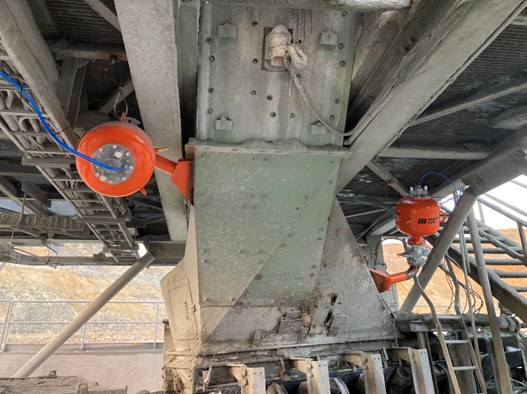
At a large gold mining operation with annual ore production capacity of more than 10 MT, conveyor systems are critical to maintaining continuous material flow and plants performance. Due to regional climate conditions and moisture in the ore, recurring material buildup inside conveyor transfer chutes led to frequent blockages and downtime. Manual cleaning was required during each shift, with each cleaning cycle taking 30-60 minutes and disrupting daily production for up to two hours. Given conveyor capacities of 2000 tonnes per hour, these stoppages resulted in significant production losses. Manual cleaning inside confined chutes also exposed personnel to elevated safety risks.
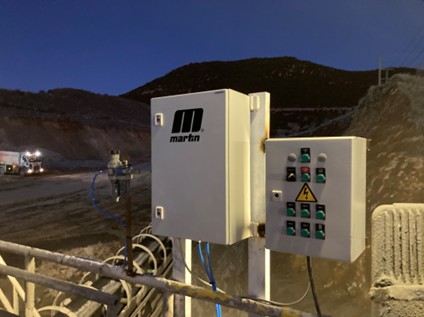
Following a detailed on-site inspection, Martin Engineering's technical team identified chute locations with a high tendency for material adhesion and buildup. A targeted Martin® Hurricane Air Cannon System was recommended to address the issue. Two air cannons were installed on the chute in a closed-loop configuration, delivering periodic high-pressure air blasts to prevent material from forming blockages and to keep the ore flowing efficiently. The fully enclosed system enabled automated operation, eliminating the need for operators to enter hazardous chute areas while ensuring safe, continuous, and reliable material flow.
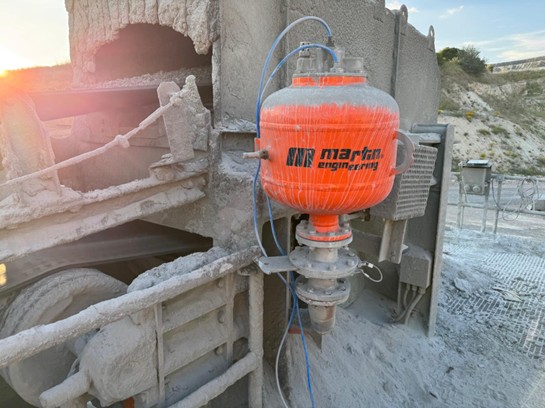
After installation, the system was monitored over a short optimization period, during which minor adjustments were made to match the chute geometry. Once optimized, material buildup and blockages were completely eliminated. The need for manual cleaning was minimized, resulting in annual labor savings ~ 600-700 working hours. Conveyor downtime was significantly reduced, improving overall production efficiency by ~2.5% and enabling ~0.3 million tonnes of additional annual output. Avoided stoppages reduced energy losses, delivered measurable power savings and cut CO₂ emissions by 60 tonnes. Following proven performance the solution was replicated at other transfer points.
| PDF - Printable Version of Case Study | Download |
+44(0)115 946 47 46
Martin Engineering Ltd.
Unit 33, The Tangent Business Hub
Weighbridge Road, Shirebrook, NG20 8RX
United Kingdom
Get Directions
info@martin-eng.co.uk
+44(0)115 946 47 46